About Germanikure
We are a family-owned company. Because we aren’t a corporation, we can do things most corporations cannot. We define our success not by the bottom line, but through quality, ethics, accountability, and affordability. We are glad you are visiting our site, and hope you will learn more about the efforts we make as a company to provide fine manicure tools at affordable prices.
Old-World craftsmanship
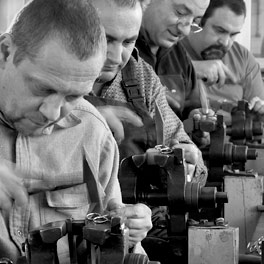
Renowned German engineering has its limits. Top-notch CNC (Computer Numerical Control) machines, grinders, high-tech mold making machines and robots will never be able to fully replace human hands. Our most valuable assets are the true artisans who learned the trade traditionally, from their fathers. Our modern machinery helps with initial shaping, but then each and every piece goes through many traditional manual steps on its way to becoming a life lasting, precision tool.
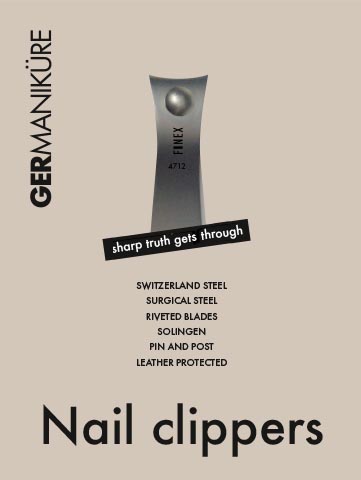
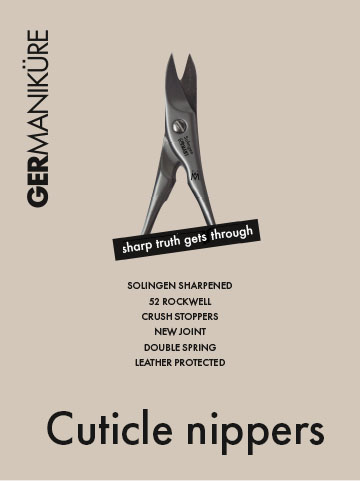
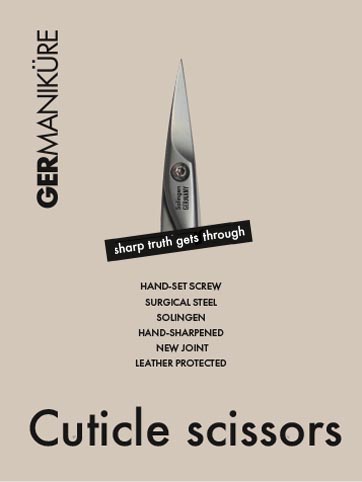
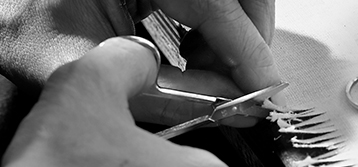
People are often surprised to learn that every single pair of our scissors is assembled by hand and every single screw is set with a screwdriver to ensure proper tension. Scissor blades are adjusted with a small hammer for precise shearing cuts. Every nipper is assembled by hand and sharpened with a file - not a grinder. Highly skilled handwork is required to make our products functionally superior and life lasting. We do not want to be in the business of selling replacements, so mass-production is simply not an option.
In life, when it is time to make a decision people usually know the right path, but often choose the easier route. It's the same in business. We know faster ways to produce our products, but not without sacrificing quality and critical functions. We also know there are cheaper production methods, but those methods do not come without environmental and societal repercussions. We chose a path that may not be as easy or profitable as it could be, but we believe it is the right path for us.
Affordability
Our tools are intentionally and deliberately priced 30-60% less than other comparable European and fine Solingen products. We also ask our stockists to keep our items attractively affordable to purchase. By supporting our beliefs, these retailers actually sacrifice a larger profit from an enormous markup. Instead, they agree to an intangible return on their investment. Unfortunately, “taking the right path” does not always look good in the annual stockholder report, which is why you’ll only see our products in places that care: small local drugstores, health stores, boutiques, or ethical nail spas and salons among others.
No child Labor
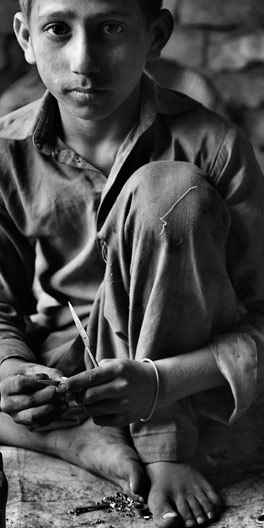
It doesn’t make the news, but the sharp truth is: the grooming tool industry is heavily supported by child labor. It is well known that Pakistan is a major producer of grooming tools sold in the U.S. The child labor laws in Pakistan state that children under 14 years old cannot work in factories or any job deemed hazardous, yet there are an estimated 11 million child laborers in Pakistan alone under 14 years of age, and most of these children are sitting on moldy floors, operating heavy machinery, and performing hazardous jobs like grinding scissors, polishing tools, or sharpening blades. While not every factory in Pakistan operates under such questionable ethics, enough of them do to warrant careful consideration.
No child labor is ever used in the manufacturing, packaging, or distribution of GERmanikure products. We ask you to please carefully consider the origins of your next tool purchase, and stop contributing to this growing worldwide child labor problem.
Earth-consciousness
At one time, Solingen was a muddy, rust-colored mess without much green space. Steel factories coated everything in a fine film of brown. Through tighter factory regulations and an influx of more caring companies, Solingen has been brought all the way back from drab desolation to a green city where children can visit the Rhine and swim in clean water.
Water
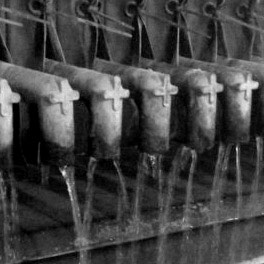
Water is a key element for most of our production operations such as grinding, drilling and sharpening. Water not only washes away steel bits but also removes glue residues, excess minerals, lubricants and silicones from grinding wheels and belts. To save money (and increase profitability), some steel factories re-use their dirty, abrasive laden, effluent for several cycles. If the water in the grinder is already filled with abrasives and steel shavings, it is difficult to control the exact sharpness of the ground edge. After re-using the muddy water as much as possible, many factories just dump it back into the ecosystem without much thought.
After each use, we collect all our water in pools under the factory, extract and recycle tons of steel grounds from it, and then filter the water back to usable condition on site. This filtered water then gets reused for our production operations. Filtering our water on site not only saves the nearby Rhine river, but also allows us to use only clean water in all of our manufacturing operations. This process also makes our tools much more precise and sharp.
Air
Re-using our water isn’t the only area where we are strict. We use industrial air filtration, exhaust hoods, and efficient air circulation on the factory floor to remove unhealthy air particulates. All of the exhaust we generate goes through filtration before it exits the factory. While manufacturing in a 100% pollution-free environment is pretty much impossible, we do our best to limit our contribution to smog. Grooming tool factories in many other countries such as Pakistan are not so careful.
Minimalist packaging
Perhaps the best way to impact the world's waste problem is to buy everything without packaging. Until that time arrives, we use the bare minimum packaging of plain, hand-stamped kraft envelopes. Marketing specialists told us that this kind of minimalistic, non-plastic, “blind” packaging wouldn’t sell products. We want to prove them wrong. Our customers are mature enough to research our quality for themselves. We are in the business of selling tools, not the package they come in. Not only is the packaging 100% biodegradable, but because each of our products also lasts a lifetime or longer, our tools will not be discarded quickly. These two things together exempt us from an alarming statistic that, quite frankly, we want no part of: nearly 3 trillion pounds of throw-away trash is created worldwide
Longevous tools
Planned obsolescence is the common manufacturing practice of designing an item with an artificially limited lifespan. Once the item becomes obsolete (via breaking, becoming dull, or unfashionable) it will need to be replaced, thereby increasing long term sales volume through repeat purchases. You’ll notice this more in the electronics industry with computers and cell phones that become obsolete each year when the next model is released, but grooming tools are not exempt. This manufacturing strategy pushes manufacturers to cut costs and skimp on quality because when items wear out faster, they are replaced quicker, and the manufacturer then reaps multiple profits from the same customer.


Upcycling
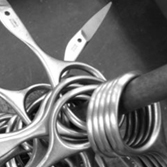
Creative people operate businesses with a distinctive “je ne sais quoi” that is anything but plain or generic. If this describes you and your business, then our generic product displays just won’t do your store justice. Don’t waste your money on them, and instead join the upcycling movement and create something worth sharing: something beautiful to match your unique personality and your store’s aesthetic. Repurpose something unusual and eye catching. Your upcycled display will not only draw attention but it will also become an interesting conversation opener and will lead to more sales.
While liking the idea of environmentally conscious choices feels good, it is the act of actually doing something about the problem that feels even better. The money and resources you save through upcycling your display will only serve to increase your bottom line, and the objects you saved from the landfill to upcycle into your display will attract attention. People like to share on social media and tell others about the interesting things they encounter, and your display will be no different. Upload an image of your creative display handiwork to your social media platforms such as Instagram or Facebook and tag it with #germanikuredisplay, and we may just share it with everyone we know.
Creative opportunity
If you are a handy DIY craftsman, we’d like to offer you an opportunity to help other businesses. Sell your unique and beautiful handcrafted displays by making a listing on our business to business network. For more information contact us at:
+1 800-784-0714
info@germanicure.com
Transparency
Cost externalization is the practice of a company maximizing profits by passing off indirect costs, and negative effects, to a third party. You don't hear much about it, and you may not even know it's happening, but it occurs every day. $0.99 drugstore fingernail clippers and other ridiculously cheap manicure products are examples.
Because of cost externalization, $0.99 is not the actual cost of those clippers. Consider that somewhere, raw material is extracted and processed to steel in factories, which often release filthy exhaust and waste water into the environment. The steel is then sent to other factories to be manufactured into thousands of clippers by children, earning pennies a day. These kids are not the end-user of the clippers they make, but they pay too: with their health, childhood, and often limbs, eyes and lungs. The clippers are then packed and shipped overseas and placed for sale. Now, consider how long those $0.99 clippers will continue to work well for you, if they even work at all. If you take the time to consider it, the actual cost is much higher. YOU aren’t paying that price. The store you bought them from or the manufacturer producing them isn’t paying that price either; yet someone in the world IS paying. This is cost externalization.
We choose to avoid cost externalization and be as honest and transparent as possible in our manufacturing and raw material sourcing. This is why our tools cost a little bit more than others. No costs in creating our tools are externalized.
Cost externalization is the practice of a company maximizing profits by passing off indirect costs, and negative effects, to a third party. You don't hear much about it, and you may not even know it's happening, but it occurs every day. $0.99 drugstore fingernail clippers and other ridiculously cheap manicure products are examples.
Wholesale inquiries
GERmanikure now offers many individuals and entities wholesale pricing opportunities to purchase our products.
Students, Professionals, Salon/Spa Owners:
If you are a current student, nail professional, or salon/spa/school owner, we now offer a special discount program for you. Please click the link below to apply:
Professional program
Retailers, Suppliers, Resellers
All beauty supply sellers and resellers are now eligible to apply for wholesale pricing. Please click the link below to register and apply:
Wholesale program
Where to find
You can find GERmanikure products at many trusted, responsible and ethical retailers and salons.
Our products are also available on Amazon.com
Our thoughts on leather
We hear you loud and clear. We’re guilty. All our products are packed in natural leather cases and sleeves. We choose leather for our cases and sleeves because, honestly, we need a case for our tools that will last just as long as the tools do, which is a lifetime. Cases made from leather are strong, cushioning, and have a mild dehumidifying effect that helps protect the steel tools we place inside.
Balancing our longevous design with our ethics led us to use leather for our cases, but only the least amount possible. Our cases are designed without excess leather covering parts of the tool that don’t need protection such as handles or springs. In this way, we can fully utilize smaller leather scraps and keep them from ending up in a landfill.
We understand the concerns and ethical questions about using leather and we are always searching for durable leather alternatives. We have found a few interesting alternatives such as mushroom leather, cork, hemp, and canvas, but our tools are either too sharp and rip through the case, or the material is prohibitively expensive.
We want our cases to be just as longevous as the tools we make, but we need your help. It is said that a thousand eyes can see things that two eyes cannot. Therefore, a network consisting of thousands of caring individuals searching for the right durable case material will have better results than one small family-owned business possibly can. If you find (or maybe you already know of) a strong, biodegradable, petroleum and plastic-free material that you think might make a good case, drop us a line at earthfriendly @ germanikure.com.